INTERNAL IMPLEMENTATION / CASE 001
From fragmented operations to one controlled operating layer.
How Morifar designed and developed an authenticated internal platform for CRM, operational cases, documents, approvals, human-controlled workflows and AI-labelled decision support.
Morifar Group28 June-5 July 2026Release Candidate
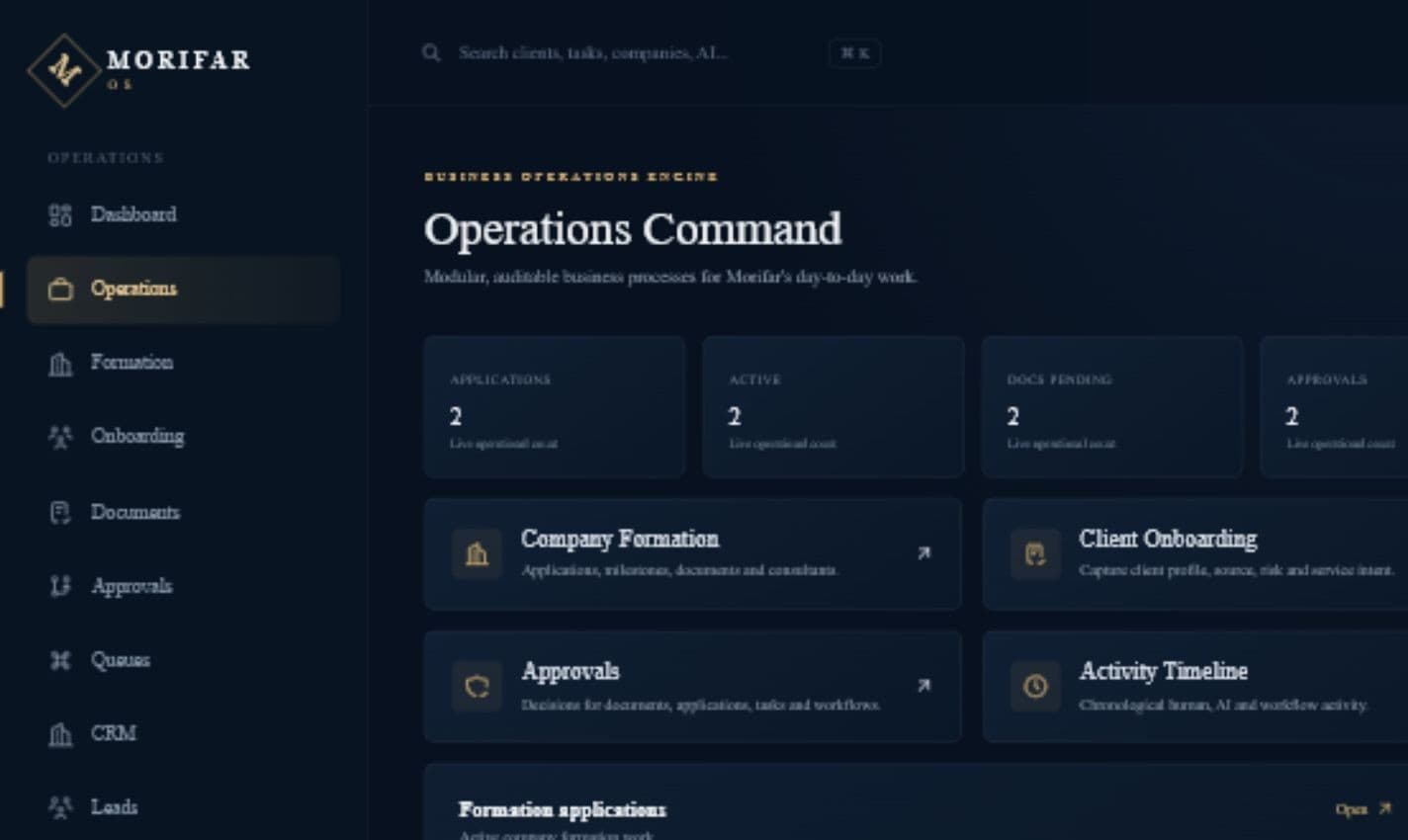
These are internal engineering and QA measures, not an independent certification or commercial-outcome study.
THE HONEST VERSION
An internal implementation—not an invented client story.
Morifar Group needed one operating environment for work distributed across companies, departments, files, conversations and individual team members. The previous model depended too heavily on fragmented files, messages, spreadsheets and staff knowledge.
- CLIENT
- Morifar Group · Dubai-based multi-entity business group
- PROVEN OUTCOME
- A functioning authenticated Release Candidate with documented modules, human-control safeguards, responsive QA evidence and reproducible build and route tests.
- CURRENT STATUS
- Suitable for internal pilot and controlled demonstrations. Not ready for durable live client records or autonomous legal, financial or government actions.
One system. Four controlled layers.
The architecture separates operating routes, domain features, repositories, deterministic services and CTO documentation so future intelligence can be connected without removing human authority.
Operations
Dashboard, CRM, leads, tasks, formation, onboarding, documents, approvals, queues and timelines.
Automation
AI Command Center, AI Professionals, Workflow Engine and Service Automation.
Intelligence
Executive Copilot, Client Intelligence, Operations Intelligence and Knowledge Base.
Control
Authentication, protected routes, human approvals, audit logs, System Status and Company Profile.
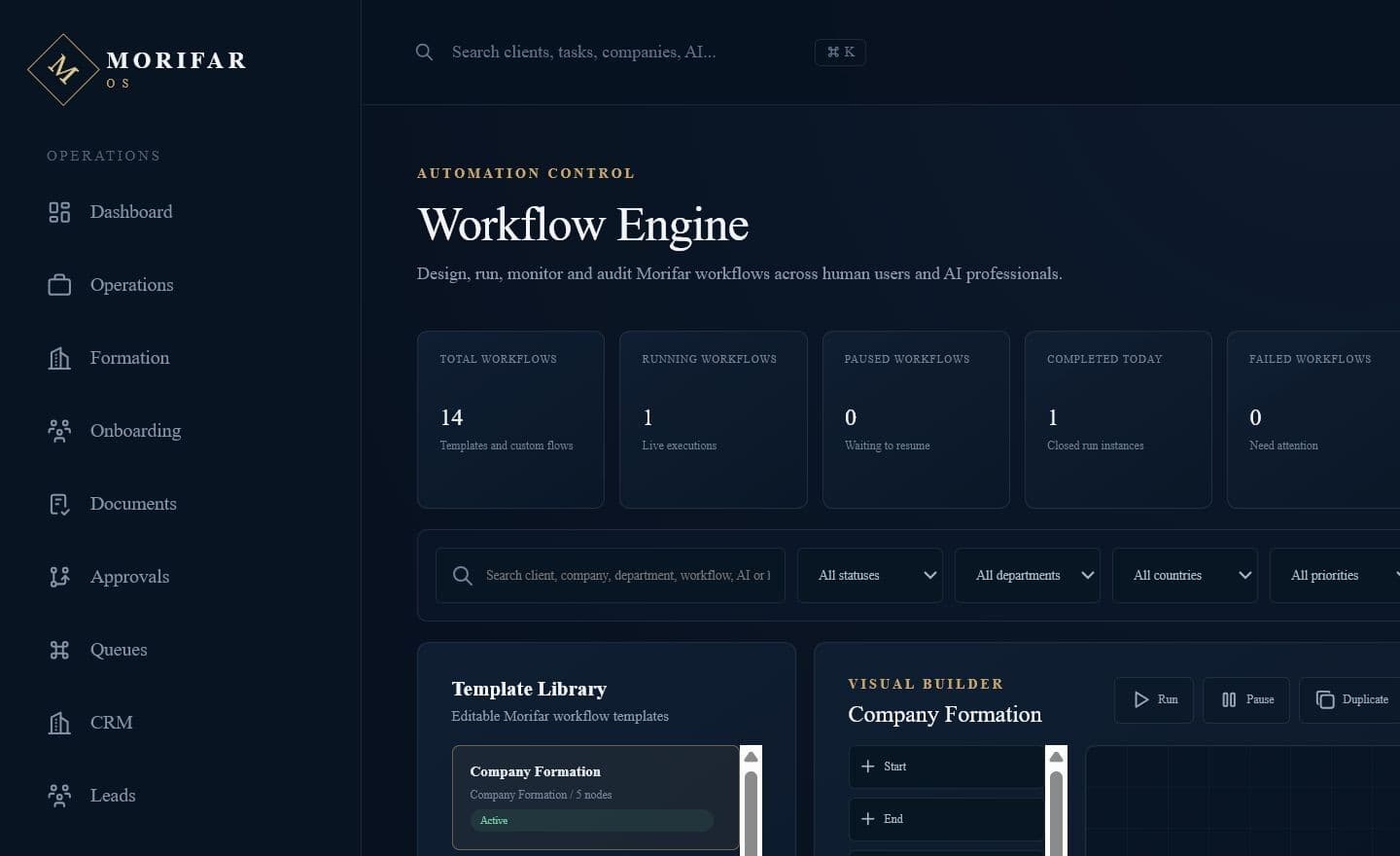
REAL PRODUCT EVIDENCE / 01
Workflow orchestration with human controls.
The Workflow Engine stores editable definitions, run records and audit activity. Webhook and API nodes remain configurable placeholders; durable external-worker orchestration is future work.
Progress that can be traced—not reconstructed after the fact.
74/100 · two server-render failures identified
Broken routes and desktop overflow addressed
84/100 then 92/100 · route smoke added
Architecture, routes, services, QA and training visibility
29/29 authenticated routes · 6/6 access checks
Only what can be proved.
MeasureInitial verified stateCurrent verified state
Full QA74/10092/100 Phase 6 · 95/100 internal RC readiness
Critical route failuresTwoZero in the 12 July authenticated smoke test
Release stateEarly internal platformVersion 1.0.0 Release Candidate
Access controlProtected redirects6/6 redirect checks passed
FAILURE-TO-FIX EVIDENCE
The original defect stays in the record.
On 28 June, the Company Formation and Create Task routes failed during server rendering. Later hardening corrected the serialization defects; the fresh 12 July test returned HTTP 200 with valid headings for both routes.
/company-formationERROR BOUNDARY → PASS 200/tasks/newERROR BOUNDARY → PASS 200
What this Release Candidate does not prove.
No cost saving, revenue growth, head-count reduction or client-turnaround claim is made. A 30-60 day controlled pilot with timestamped baselines is required before publishing operating outcomes.
- 01Durable live client records require migration from ephemeral SQLite storage.
- 02The current intelligence provider is deterministic and rule-based; live model orchestration is not connected.
- 03Government, banking, email, WhatsApp and payment integrations are not live.
- 04Secure file uploads, OCR and malware scanning are not production-ready.
- 05Workflow execution is not yet backed by a durable background worker.
- 06No penetration test, independent accessibility certification or external product audit has been completed.
Inspect the complete case-study record.
The publication includes implementation scope, screenshots, development chronology, failure-to-fix evidence, a fresh verification summary and the full limitation register.
Open evidence-backed PDF